


SOHOB’s Enterprise AI Strategy for Saudi Organizations provides a business-first framework for turning AI ambition into measurable enterprise value. Designed for Saudi leaders, it connects strategy, data, architecture, operating model, responsible AI, adoption and value realization within one practical transformation approach.
The framework aligns enterprise execution with Saudi Arabia’s digital transformation direction and provides decision tools for prioritizing investments, governing risk and scaling AI responsibly. The complete designed report is available for download below.
Executive Summary
A business-first enterprise AI operating system for Saudi organizations

The original SOHOB article correctly emphasized that enterprise AI must be linked to business strategy, supported by data and architecture, governed responsibly, and translated into an executable roadmap. This redesigned edition turns those ideas into a distinct SOHOB methodology rather than relying on external frameworks as the core intellectual structure.
SOHOB POINT OF VIEW
Saudi organizations do not need another AI vision statement. They need a repeatable system for selecting the right AI investments, governing risk, building enterprise capabilities and proving value at scale.
What is new in this framework
| SOHOB method | Purpose |
|---|---|
| Enterprise AI Value Framework | Six domains connecting AI investment to measurable enterprise value. |
| SEAMI Maturity Index | Five-stage evidence-based maturity model scored across the six domains. |
| AI Value Prioritization Method | Weighted scoring to rank use cases by value, readiness, feasibility and risk. |
| Responsible AI Governance Model | Decision rights, governance gates and ongoing assurance. |
| Enterprise AI Reference Architecture | Vendor-neutral layers for secure, composable and governed AI. |
| AI Transformation Lifecycle | ASSESS → ALIGN → ARCHITECT → ACTIVATE → SCALE → ASSURE. |
Design principle
External research is used as evidence, not as SOHOB intellectual property. Distinctive third-party wording and named frameworks are not reproduced as SOHOB content. Each major recommendation is expressed as a SOHOB decision rule, method, artefact or operating practice.
External evidence: [5], [6], [9]
Enterprise AI Strategy in the Saudi Context
Why 2026 requires enterprise-grade strategy, governance and execution

Saudi Arabia has designated 2026 as the Year of Artificial Intelligence, reinforcing AI as a national strategic priority. Vision 2030 reporting also frames AI as part of a broader national ecosystem that depends on data governance, trusted regulation, research capacity and talent—not technology deployment alone. [1][10]
External evidence that shapes the SOHOB thesis
| Evidence | Implication for Saudi leaders |
|---|---|
| Deloitte 2026: only 30% of surveyed organizations report redesigning key processes around AI; 21% report a mature model for agent governance. [6] | Move from pilots to process redesign, operating-model change and explicit governance. |
| Accenture Middle East: 9% of surveyed regional organizations met the “Reinventor” criteria in its study. [7] | AI advantage compounds when technology is paired with continuous enterprise reinvention. |
| OpenAI enterprise research: deeper organizational integration and workflow standardization distinguish frontier firms; readiness remains a major constraint. [8] | Adoption depth, data context, reusable workflows and change management matter as much as model choice. |
| SDAIA AI Adoption Framework and AI Ethics Principles provide national reference points for adoption and responsible use. [2][3] | Strategy and governance should align to the Saudi regulatory and ethical context from the outset. |
SOHOB PERSPECTIVE
The central management challenge is not “Which model should we buy?” It is “Which enterprise outcomes should AI change, what capabilities are required, how will risk be governed, and how will value be measured?”
Executive mandate for 2026
- Treat AI as an enterprise transformation portfolio, not a collection of disconnected use cases.
- Create accountable C-suite ownership for value, governance and adoption.
- Build a governed data and knowledge foundation before scaling autonomous or agentic workflows.
- Design for Saudi privacy, data governance, cybersecurity and responsible-AI requirements by default.
- Measure business outcomes—revenue, cost, service, risk, cycle time and capacity—not model activity.
External evidence: [1], [2], [3], [6], [7], [8], [10]
SOHOB Enterprise AI Value Framework
Six interconnected domains that convert AI investment into measurable enterprise value

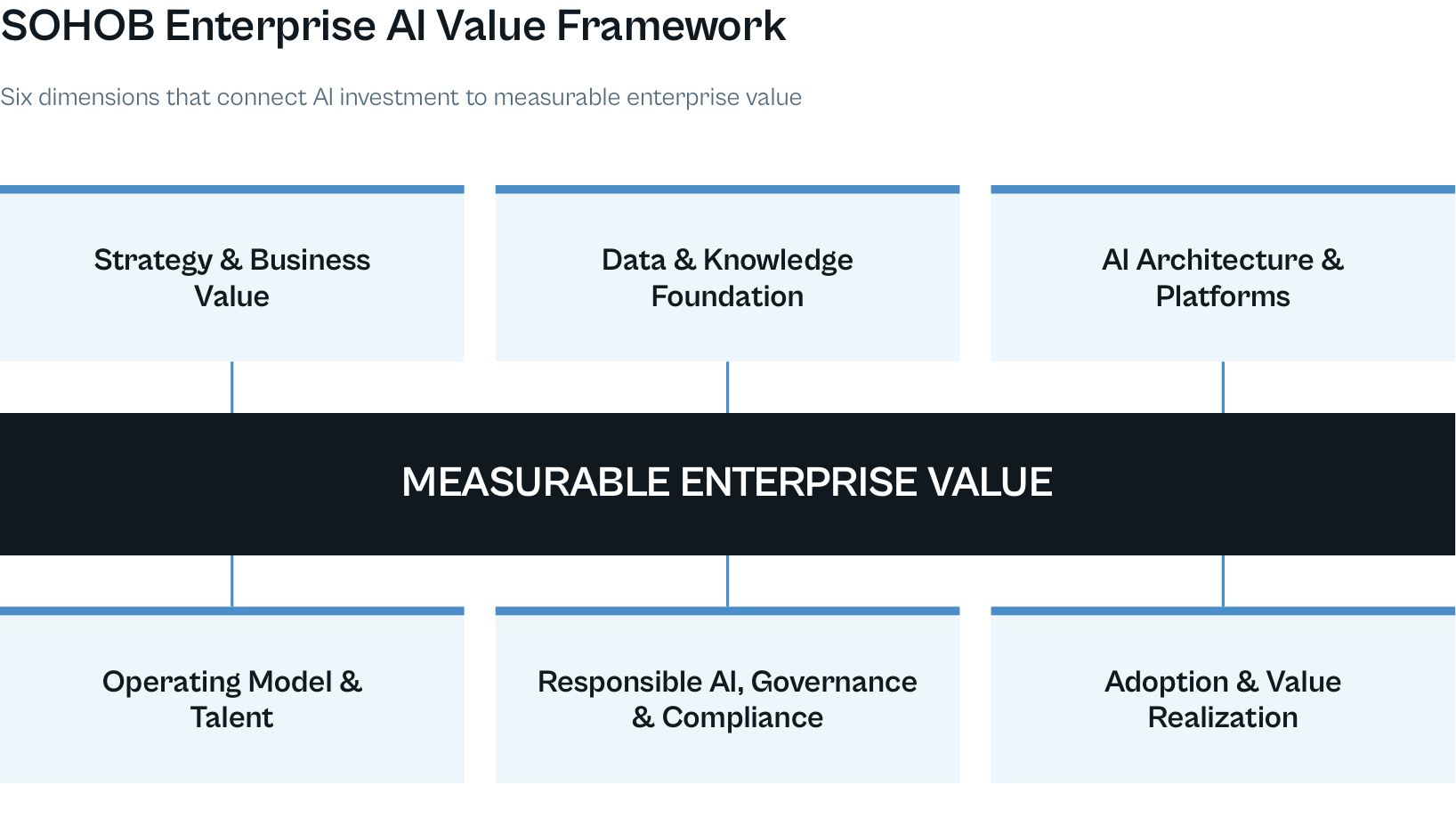
| Domain | Core management question |
|---|---|
| 1. Strategy & Business Value | What outcomes and competitive advantages should AI accelerate? |
| 2. Data & Knowledge Foundation | Can trusted enterprise data and knowledge safely support AI decisions? |
| 3. AI Architecture & Platforms | Can AI be integrated, scaled, observed and changed without lock-in? |
| 4. Operating Model & Talent | Who owns AI, who builds it, and how will work and skills change? |
| 5. Responsible AI, Governance & Compliance | What controls keep AI lawful, safe, explainable, accountable and auditable? |
| 6. Adoption & Value Realization | Are people using AI in redesigned workflows and are benefits being realized? |
DECISION RULE
A use case should not move to enterprise scale when one of the six domains is materially unready. SOHOB assessments therefore evaluate the system of capabilities—not technology in isolation.
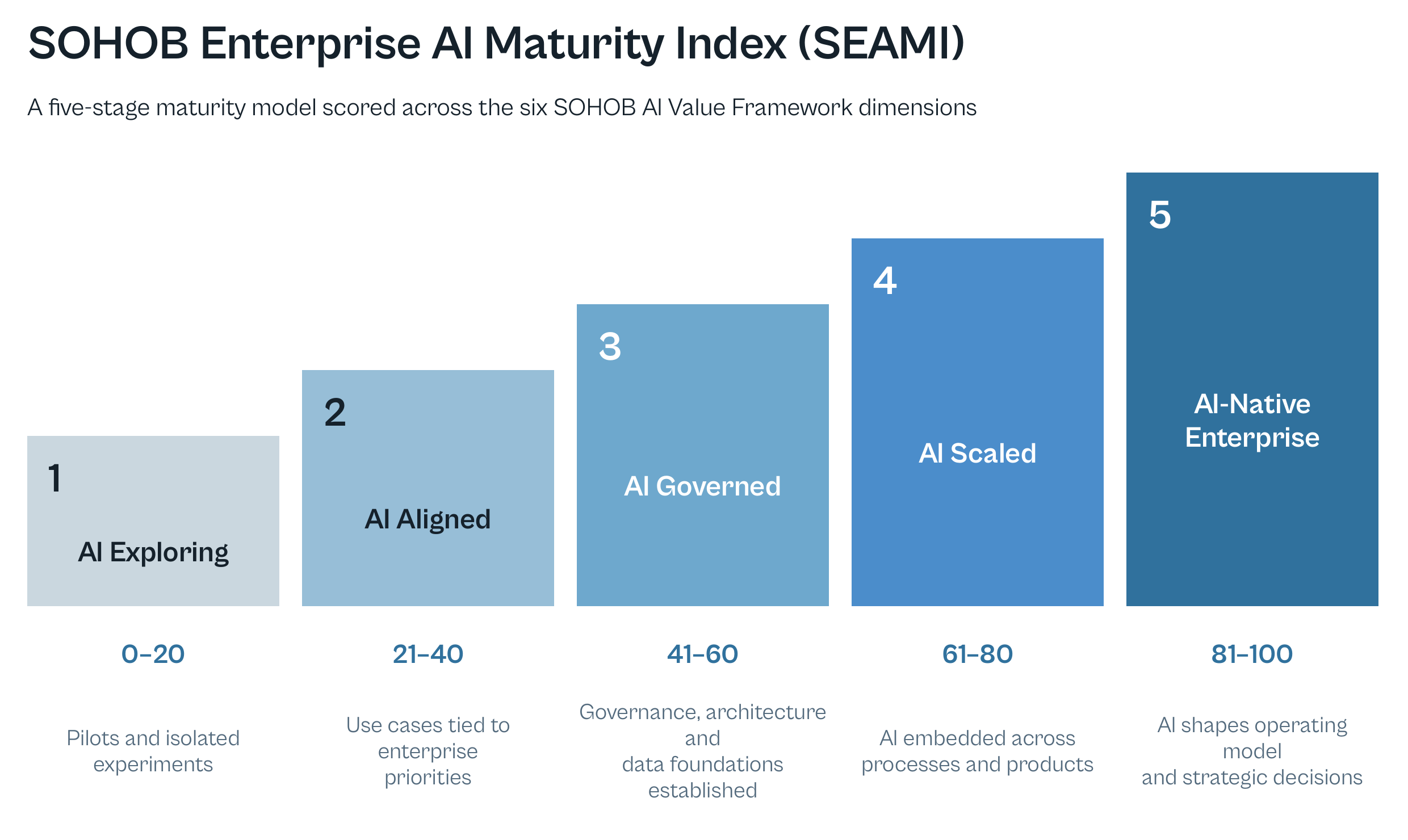
SOHOB Enterprise AI Maturity Index (SEAMI)
A five-stage maturity model scored across the six SOHOB value domains

Scoring logic
Each of the six domains is scored using evidence-based criteria. The default overall index is a weighted average normalized to 100; sector-specific engagements may adjust weights. A maturity stage is assigned only when the organization satisfies both the score threshold and the minimum control requirements for that stage.
| Stage | Score | Minimum enterprise condition |
|---|---|---|
| 1 — AI Exploring | 0–20 | Pilots and experiments; limited enterprise ownership or common controls. |
| 2 — AI Aligned | 21–40 | Priority use cases linked to enterprise objectives and accountable sponsors. |
| 3 — AI Governed | 41–60 | Core governance, architecture, data controls and delivery standards established. |
| 4 — AI Scaled | 61–80 | Reusable capabilities, production monitoring and adoption across multiple domains. |
| 5 — AI-Native Enterprise | 81–100 | AI influences operating model, products, workforce and strategic decisions continuously. |
EVIDENCE RULE
SEAMI is not a self-perception survey. Scores should be backed by artefacts such as approved strategy, architecture decisions, data controls, model inventories, risk assessments, production metrics, adoption data and realized-benefit evidence.
Domain 1 — Strategy & Business Value
Start with enterprise outcomes, not tools

The SOHOB method begins with the business strategy and works backward to identify where AI can change economics, service, risk or competitive position. This retains the strongest principle from the original article while expressing it as an explicit SOHOB operating method. Deloitte similarly argues that effective AI strategy should begin with the core business strategy rather than isolated use cases. [5]
Enterprise AI Strategy Deliverables
| Artefact | What it establishes |
|---|---|
| AI Ambition & North Star | The role AI should play in the organization over a 2–3 year horizon. |
| Enterprise Outcome Tree | Strategic objective → value driver → process → AI opportunity → KPI. |
| AI Investment Thesis | Where to invest, where not to invest, and acceptable return/risk thresholds. |
| Use-Case Portfolio | Balanced portfolio of quick wins, strategic bets and foundational enablers. |
| Benefits Register | Baseline, target, owner, realization date, evidence source and finance validation. |
Outcome categories
- Growth: conversion, cross-sell, new digital products, personalization, market expansion.
- Efficiency: cycle time, automation, productivity, cost-to-serve, asset utilization.
- Experience: citizen/customer satisfaction, employee experience, service quality and accessibility.
- Risk & resilience: fraud, compliance, quality, forecasting, operational risk and cybersecurity.
- Strategic capacity: faster decisions, simulation, scenario planning and institutional knowledge reuse.
SOHOB PERSPECTIVE
Every AI initiative should have a named business owner, baseline metric, target outcome and value hypothesis before architecture or model selection begins.
External evidence: [5], [6]
Domain 2 — Data & Knowledge Foundation
Create trusted context for enterprise AI

AI systems become enterprise capabilities only when they can work with trusted organizational context. The SOHOB data foundation combines conventional data governance with knowledge management for generative and agentic AI.
Foundation layers
| Layer | SOHOB design expectation |
|---|---|
| Data ownership & governance | Named owners/stewards, classification, quality rules, lifecycle and lineage. |
| Integration & data products | Reusable governed datasets/APIs aligned to business domains. |
| Metadata & semantics | Business glossary, metadata, ontologies/taxonomies where needed. |
| Enterprise knowledge | Approved documents, policies and knowledge sources prepared for retrieval. |
| AI context services | Vector search, knowledge graph/RAG patterns, access control and grounding. |
| Data observability | Quality, freshness, lineage, access and usage monitoring. |
Saudi compliance design
The Saudi Personal Data Protection Law (PDPL) is the Kingdom’s key law for personal data protection. SOHOB designs AI data flows to identify personal data, purpose, lawful basis, access, retention, cross-border considerations and data-subject obligations early in the lifecycle. [4]
SOHOB ARCHITECTURE RULE
Do not connect a model or agent directly to “all enterprise data.” Create explicit, governed context products with least-privilege access, provenance and purpose-specific controls.
Readiness evidence
- Critical data domains inventoried and owned.
- Priority use cases mapped to authoritative data/knowledge sources.
- Data quality and metadata thresholds defined.
- AI-access patterns approved by privacy, security and data governance.
- Retrieval outputs evaluated for relevance, provenance and leakage risk.
External evidence: [2], [4]
Domain 3 — AI Architecture & Platforms
A vendor-neutral architecture for secure, composable and governed AI

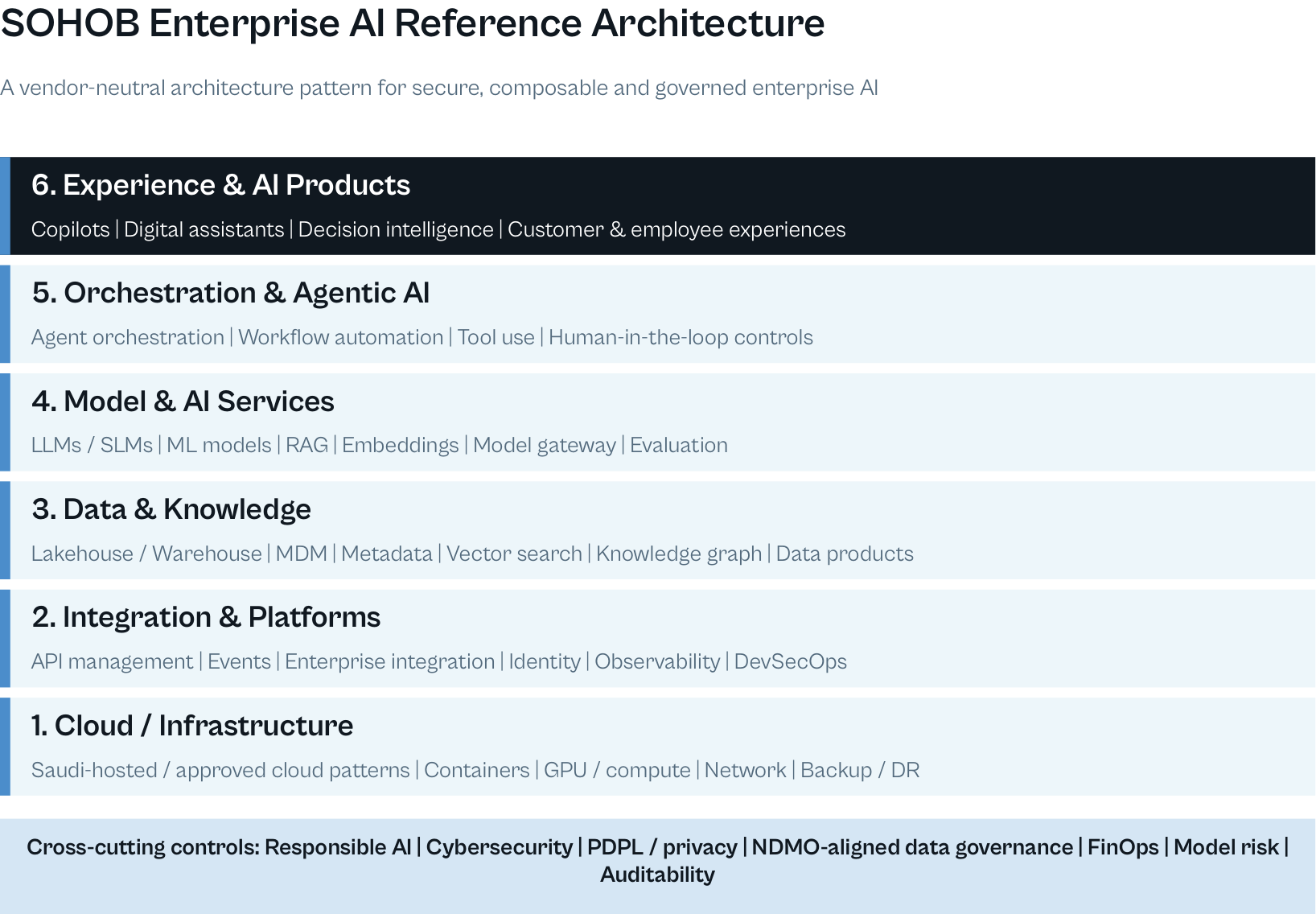
SOHOB architecture principles
| Principle | Design rule |
|---|---|
| Composable | Models, tools and channels can change without rebuilding the enterprise stack. |
| Context-aware | AI receives only the trusted data, knowledge, identity and tools required for the task. |
| Model-flexible | Use a controlled model gateway or abstraction pattern where justified. |
| Observable | Track quality, latency, cost, safety, drift, tool actions and business outcomes. |
| Secure by design | Identity, secrets, network, content, data and tool permissions are enforced end-to-end. |
| Human-controllable | High-impact decisions and autonomous actions include approval, override and escalation controls. |
AGENTIC AI RULE
Agent autonomy should increase only as controls mature. Start with bounded tasks and explicit tools; expand autonomy after evaluation, monitoring, failure-handling and human oversight are proven.
External evidence: [6], [8]
Domain 4 — Operating Model & Talent
Make AI a managed enterprise capability

Technology and data are necessary but insufficient. The operating model defines who sets standards, who owns value, who builds AI products, who accepts risk and how new ways of working spread across the organization.
Recommended federated model
| Layer | Accountability |
|---|---|
| Executive sponsor / AI Steering Committee | Enterprise ambition, investment priorities, risk appetite and value realization. |
| Enterprise AI Office / CoE | Standards, architecture patterns, reusable platforms, governance coordination, portfolio visibility. |
| Business domain AI product teams | Use-case ownership, process redesign, delivery, adoption and outcome KPIs. |
| Data / Cyber / Privacy / Risk / Legal | Independent or second-line controls, review and policy interpretation. |
| Platform & engineering teams | Secure runtime, integration, DevSecOps/MLOps/LLMOps, observability and reliability. |
| AI champions / change network | Local enablement, training, workflow adoption and feedback loops. |
Critical capabilities
- AI product management and business process redesign.
- Data engineering, knowledge engineering and AI platform engineering.
- Model evaluation, prompt/agent design, red teaming and monitoring.
- Responsible AI, privacy, cybersecurity and model risk management.
- Change leadership, AI literacy, role redesign and workforce planning.
SOHOB PERSPECTIVE
The central AI team should be small enough to avoid becoming a delivery bottleneck and strong enough to enforce reusable standards. Business domains must remain accountable for outcomes.
External evidence: [2], [8]
Domain 5 — Responsible AI, Governance & Compliance
Govern decisions, models, agents, data and outcomes

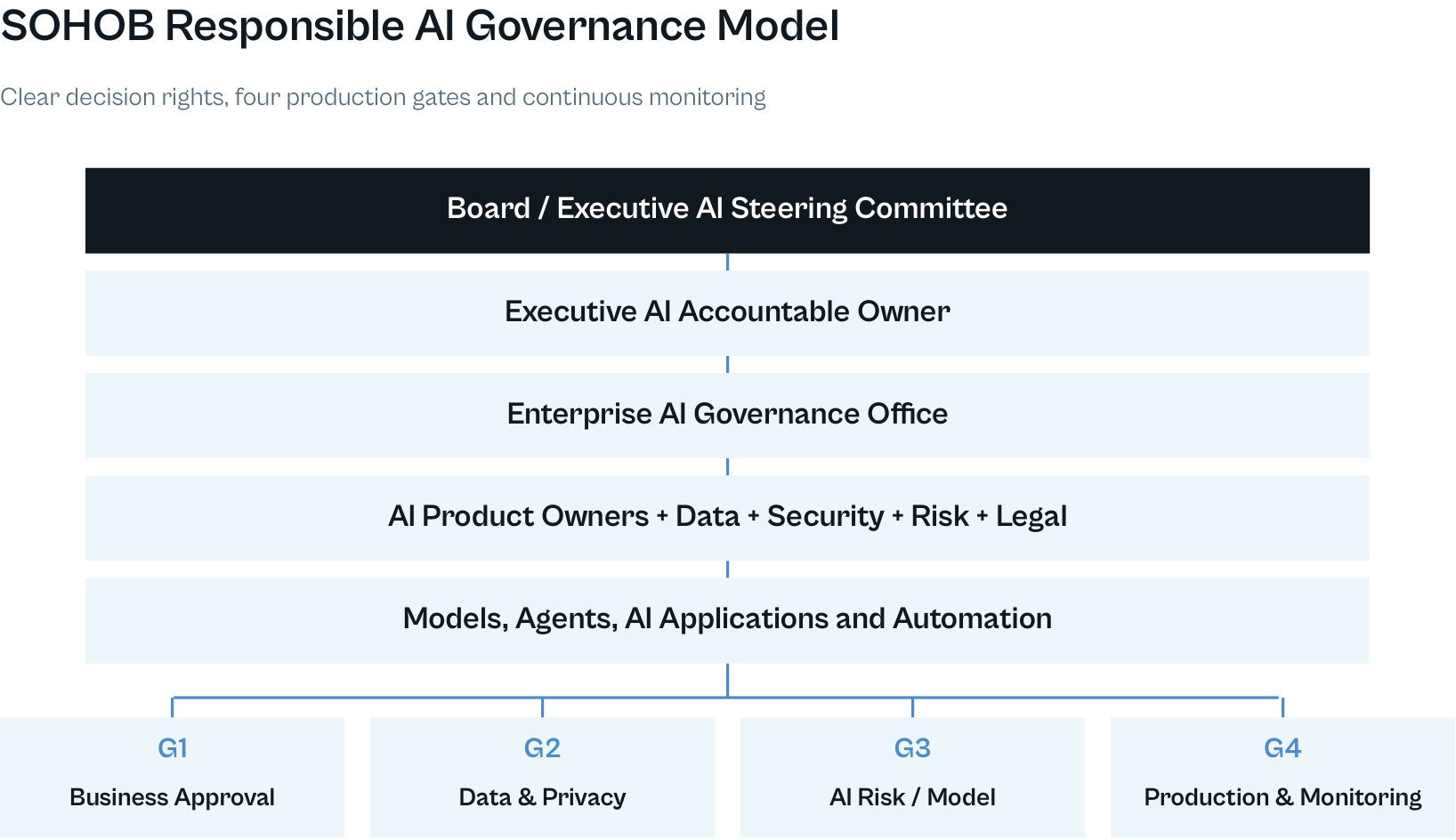
SDAIA’s AI Ethics Principles identify national expectations including integrity and fairness, privacy and security, reliability and safety, transparency and interpretability, and accountability and responsibility. SOHOB converts these principles into operational decision rights, lifecycle controls and evidence. [3]
Four SOHOB governance gates
| Gate | Required decision |
|---|---|
| G1 — Business & Risk | Is the use case justified, owned, classified and within risk appetite? |
| G2 — Data & Privacy | Are data sources, purpose, access, residency/transfer and privacy controls acceptable? |
| G3 — Model / Agent Validation | Do evaluations demonstrate adequate quality, safety, security and controllability? |
| G4 — Production & Monitoring | Are monitoring, incident response, human oversight, auditability and revalidation in place? |
GOVERNANCE DESIGN PRINCIPLE
The control intensity should be proportional to impact and autonomy. A low-risk drafting assistant should not require the same controls as an agent that can execute transactions or influence regulated decisions.
External evidence: [2], [3], [4]
Domain 6 — Adoption & Value Realization
Turn deployed AI into changed work and verified benefits

Adoption is not measured by licenses, prompts or model calls. It is measured by changed workflows and business outcomes. OpenAI enterprise research reports that workers who use AI more deeply across tasks report larger time savings, while frontier firms demonstrate deeper integration and workflow standardization. [8]
SOHOB adoption model
| Stage | Management focus | Evidence |
|---|---|---|
| Aware | Role-based communication and AI literacy | Reach, training completion, readiness pulse |
| Trial | Safe experimentation in defined workflows | Active users, task coverage, quality feedback |
| Adopt | Standard operating procedure changes | Repeat usage, process compliance, manager adoption |
| Embed | AI integrated into systems and role design | Cycle-time / quality shifts, workflow automation |
| Optimize | Continuous improvement and value expansion | Verified benefits, redesign backlog, reuse rate |
Benefits realization controls
- Record baseline before implementation; define the counterfactual where practical.
- Assign every benefit to a business owner and a finance/PMO validation mechanism.
- Separate capacity released from cashable savings; do not claim both without evidence.
- Measure quality, service, risk and revenue effects alongside productivity.
- Track adoption leading indicators and financial/operational lagging indicators.
SOHOB VALUE RULE
An AI product is not “successful” because it reached production. It is successful when the intended workflow changes and the agreed business metric improves with acceptable risk.
External evidence: [6], [8]
SOHOB AI Value Prioritization Method
Rank opportunities before committing architecture and delivery capacity

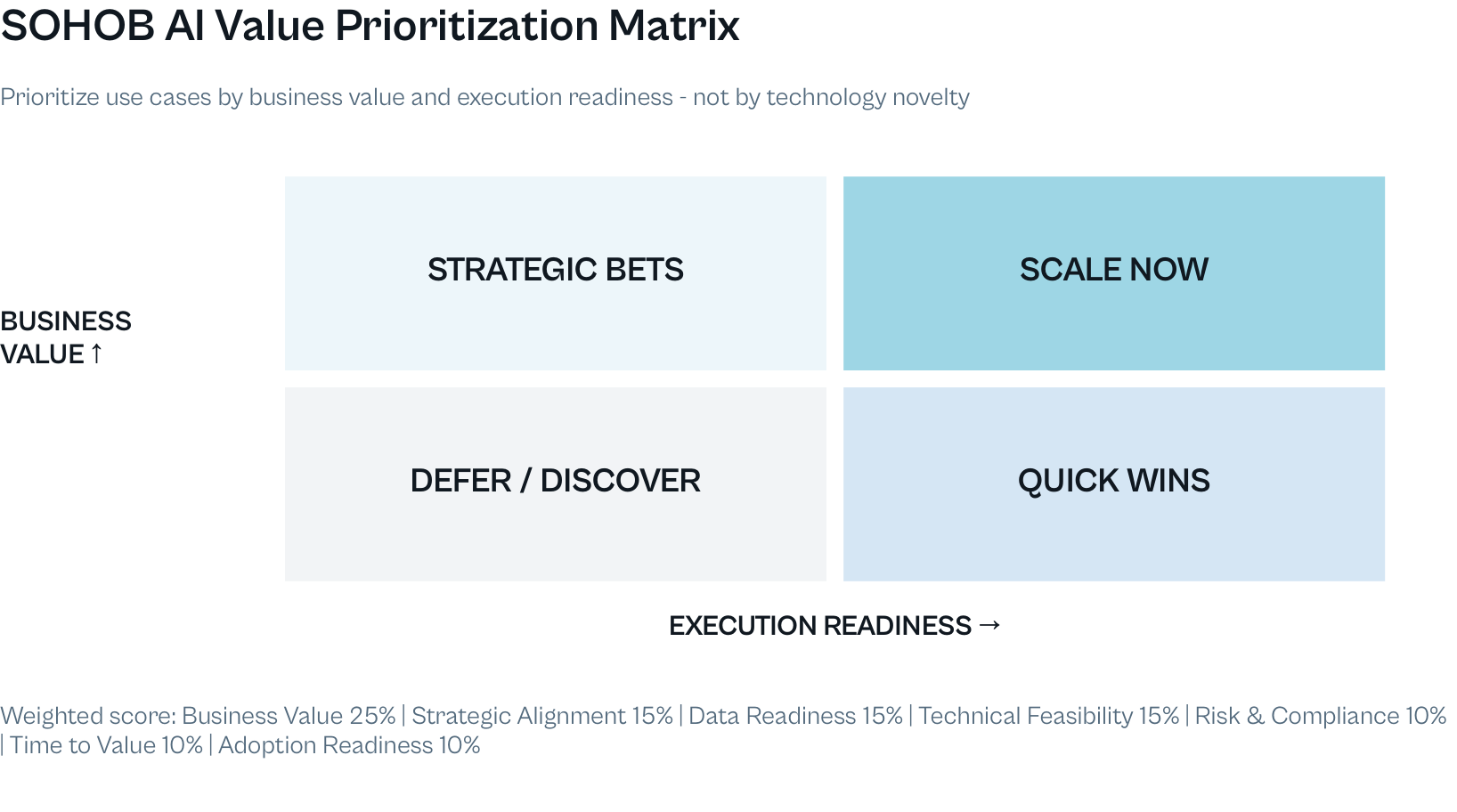
Default weighted score
| Criterion | Weight | Scoring question |
|---|---|---|
| Business value | 25% | What measurable financial, service, risk or strategic impact is possible? |
| Strategic alignment | 15% | How directly does the use case support enterprise priorities? |
| Data readiness | 15% | Are trusted data/knowledge and permissions available? |
| Technical feasibility | 15% | Can the solution meet required quality, integration and reliability? |
| Risk & compliance readiness | 10% | Can material risks be controlled within appetite? |
| Time to value | 10% | How quickly can evidence of value be produced? |
| Adoption readiness | 10% | Are process owners, users and change conditions ready? |
Weighted score = Σ (criterion score 1–5 × criterion weight). Convert to a 100-point portfolio score. Use a separate mandatory risk classification so a high value score cannot override an unacceptable control gap.
PORTFOLIO RULE
Select a balanced wave: 2–3 quick wins that prove adoption and value, 1–2 strategic bets that change a core process, and the minimum foundational investments required to scale safely.
SOHOB AI Governance Operating Model
Clear forums, decision rights and evidence across the AI lifecycle

Governance forums
| Forum | Primary decisions | Cadence |
|---|---|---|
| Board / Executive Committee | AI ambition, material risk, strategic investment and enterprise outcomes | Quarterly / as required |
| AI Steering Committee | Portfolio prioritization, funding, risk appetite interpretation, escalations | Monthly |
| AI Governance Council | Standards, gate approvals, exceptions, incidents, model/agent inventory | Biweekly / monthly |
| Architecture & Data Review | Patterns, integration, data access, platform reuse and non-functional requirements | Weekly / by gate |
| AI Product Review | Delivery, evaluation, adoption, benefits, quality and operational issues | Weekly / sprint |
Minimum decision-rights matrix
| Decision | Accountable | Required consultation |
|---|---|---|
| Approve use case and value case | Business executive owner | AI Office, Finance/PMO, Risk |
| Approve data/knowledge access | Data owner | Privacy, Cybersecurity, Architecture |
| Approve production deployment | AI product owner / delegated authority | Model validation, Cyber, Risk, Operations |
| Accept material residual AI risk | Authorized risk owner | Legal/Compliance, AI Governance Council |
| Retire or suspend AI capability | Service owner / AI Governance | Business owner, Risk, Operations |
AUDITABILITY REQUIREMENT
Every material AI capability should have an owner, purpose, risk class, approved data sources, model/agent version, evaluation evidence, monitoring thresholds, incident path and retirement criteria.
SOHOB AI Transformation Lifecycle
A repeatable consulting and transformation method from diagnosis to sustained value

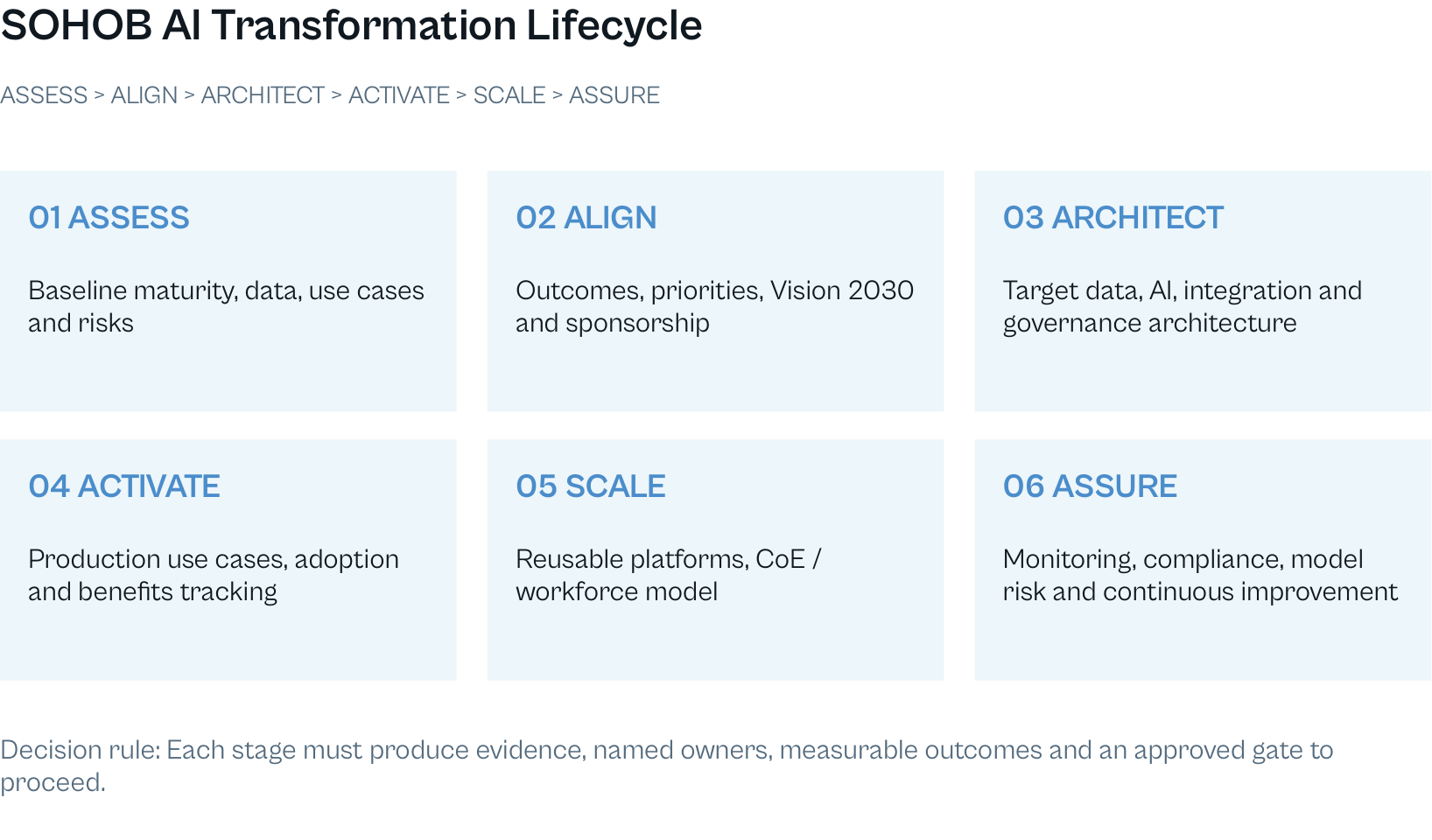
| Phase | Core activities | Primary outputs |
|---|---|---|
| ASSESS | Maturity, portfolio, data, architecture, governance and adoption diagnostic | SEAMI baseline, risk heatmap, opportunity inventory |
| ALIGN | Executive ambition, target outcomes, investment thesis and priorities | AI North Star, outcome tree, portfolio principles |
| ARCHITECT | Target architecture, data/knowledge foundation, governance and operating model | Reference architecture, governance model, roadmap |
| ACTIVATE | Pilot-to-production delivery of priority use cases and foundations | Production MVPs, evaluations, controls, adoption plan |
| SCALE | Reusable platforms, domain rollout, role redesign and capability building | Scaled portfolio, AI CoE/federated model, playbooks |
| ASSURE | Benefits, performance, compliance, incident management and continuous improvement | Value dashboards, assurance reviews, optimization backlog |
SOHOB ENGAGEMENT PRINCIPLE
Every phase ends with an executive decision and tangible artefacts. The lifecycle is iterative: assurance findings and value evidence feed the next prioritization and architecture cycle.
Enterprise AI Strategy: CEO / CIO 90-Day Action Plan
A practical first quarter for moving from AI ambition to governed execution

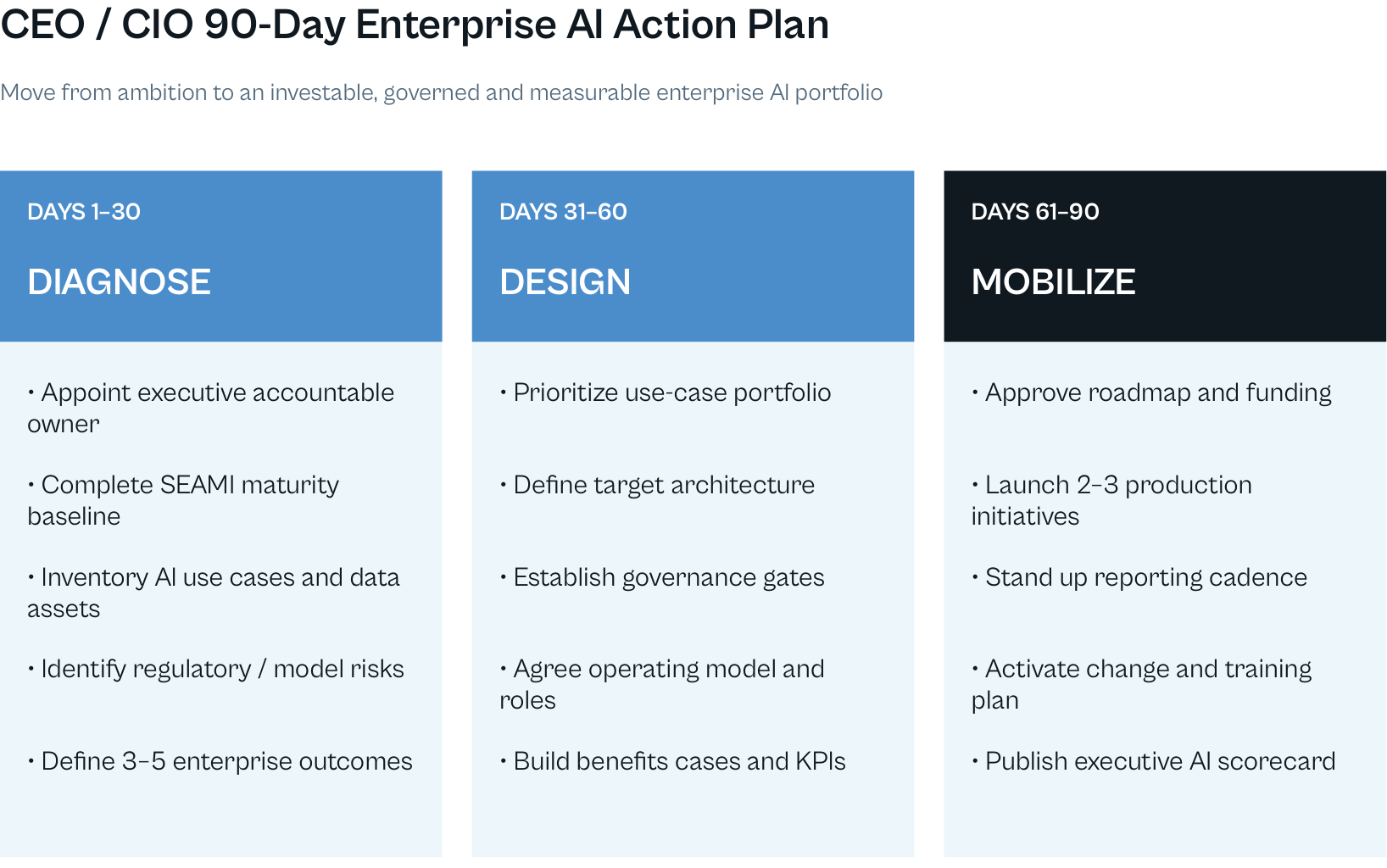
| Days | Executive actions | Decision at end of period |
|---|---|---|
| 0–30 | Appoint accountable sponsor; establish temporary AI steering forum; inventory current pilots; run SEAMI baseline; identify top strategic outcomes; classify material risks. | Agree AI ambition, governance ownership and diagnostic baseline. |
| 31–60 | Prioritize use cases; define target architecture principles; map critical data/knowledge; establish governance gates; design operating model and benefits approach. | Approve first-wave portfolio, foundations and investment envelope. |
| 61–90 | Launch 2–3 value proofs and one foundational workstream; implement evaluation and monitoring; mobilize change champions; define 12–18 month roadmap. | Authorize scale decisions based on evidence, not enthusiasm. |
CEO / CIO questions to ask every month
- Which business metric is each priority AI initiative expected to change?
- Which use cases are blocked by data, governance, architecture or adoption—not model capability?
- What new risks are created by increasing autonomy or access to enterprise tools?
- What benefits have been independently verified?
- Which reusable capability created this month will reduce the cost/time of the next use case?
90-DAY OUTCOME
By Day 90, leadership should have a governed portfolio, clear decision rights, a target architecture, an evidence-based roadmap and at least one measurable production-value path.
SOHOB Enterprise AI Strategy Assessment
An evidence-led diagnostic that produces a prioritized transformation roadmap

Assessment structure
| Dimension | Illustrative evidence reviewed | Assessment outcome |
|---|---|---|
| Strategy & Business Value | Corporate strategy, KPIs, AI portfolio, business cases, benefits tracking | Clarity of AI ambition, value logic and investment discipline |
| Data & Knowledge | Data governance, quality, metadata, access, knowledge sources, RAG/semantic patterns | Context readiness and data-control gaps |
| Architecture & Platforms | Cloud, integration, identity, AI platforms, model gateway, observability, DevSecOps | Scalability, composability, resilience and control maturity |
| Operating Model & Talent | Accountabilities, AI CoE, product model, roles, skills, training and change network | Delivery ownership and capability gaps |
| Responsible AI & Compliance | Policies, risk tiers, PDPL controls, model inventory, evaluations, incidents | Risk governance and assurance maturity |
| Adoption & Value Realization | Usage, process redesign, SOPs, benefit baselines, finance validation | Adoption depth and proven value |
Evidence scale
| Score | Evidence standard |
|---|---|
| 0 — Not present | No reliable evidence or only informal discussion. |
| 1 — Emerging | Isolated practice; owner or artefact incomplete. |
| 2 — Defined | Documented and approved for part of the organization. |
| 3 — Operational | Implemented across target scope with repeatable evidence. |
| 4 — Measured | Performance monitored; exceptions and outcomes tracked. |
| 5 — Optimizing | Continuous improvement, benchmarking and enterprise reuse demonstrated. |
ASSESSMENT DELIVERABLES
Executive heatmap • SEAMI score • top risks • prioritized opportunity portfolio • target-state design • 90-day actions • 12–18 month roadmap • investment themes • governance decisions required.
SOHOB Client Engagement, Deliverables & IP Discipline
Turn the framework into a reusable consulting product while preserving research integrity

Suggested consulting package
| Workstream | Core deliverables |
|---|---|
| 1. Executive alignment | AI ambition, outcome tree, investment thesis, executive workshop readout |
| 2. SEAMI assessment | Evidence pack, maturity scores, peer-informed heatmap, priority gaps |
| 3. Portfolio design | Use-case inventory, value prioritization matrix, first-wave business cases |
| 4. Target operating model | Governance forums, RACI/decision rights, AI Office / CoE design, talent roadmap |
| 5. Target architecture | Reference architecture, data/knowledge patterns, platform principles, non-functional requirements |
| 6. Responsible AI | Risk taxonomy, governance gates, control catalogue, model/agent inventory approach |
| 7. Transformation roadmap | 90-day plan, 12–18 month roadmap, investment themes, benefits dashboard |
Rules for genuine SOHOB ownership
- Create the SOHOB methods from first principles; do not rename a third-party named framework and claim it as proprietary.
- Keep dated workshop notes, working papers, version history and internal approvals showing how the framework was developed.
- Ensure employee, freelancer, agency and subcontractor agreements assign relevant IP rights to SOHOB where appropriate.
- Use external statistics and concepts as cited evidence; avoid carrying over distinctive wording, diagrams or model names.
- Before public release, run plagiarism/similarity review plus legal/IP review of proprietary claims, trademarks, licences and contributor rights.
RECOMMENDED PUBLICATION NOTICE
© 2026 SOHOB Arabia Information Technology. SOHOB-developed frameworks and visual models in this publication are proprietary subject to applicable agreements and legal review. Third-party research, trademarks and publications remain the property of their respective owners and are cited for research and informational purposes.
Research & References
External evidence supporting the publication; external sources are not SOHOB intellectual property

[1] Saudi Vision 2030 — Annual Report 2025
[2] Saudi Data & AI Authority (SDAIA) — AI Adoption Framework
[3] SDAIA — AI Ethics Principles
[4] SDAIA / National Data Governance Platform — Guide to the Saudi Personal Data Protection Law (PDPL) for Controllers and Processors Open source
[5] Deloitte — How to Create an Effective AI Strategy / State of AI in the Enterprise, 4th Edition Open source
[6] Deloitte — State of AI 2026: From Ambition to Activation / enterprise AI transformation findings Open source
[7] Accenture — Building Tomorrow’s Economies: How Generative AI Will Reinvent Business in the Middle East Open source
[8] OpenAI — The State of Enterprise AI 2025 Open source
[9] Jibran Bashir (2024) — Strategic Enterprise Artificial Intelligence (The Conceptual Hierarchical Framework), IJBMS 5(5), DOI 10.56734/ijbms.v5n5a13. Reviewed as a source used by the original draft; its four-level model is not reproduced as the SOHOB maturity model. Open source
[10] SDAIA — 2026 Year of Artificial Intelligence / responsible AI news and publications Open source
CITATION POLICY
Use external evidence to support SOHOB conclusions, but do not present third-party frameworks, statistics, diagrams, trademarks or distinctive wording as SOHOB-owned. Verify source currency before each new publication edition.
Internal source transformed
SOHOB, “Enterprise AI Strategy for Saudi Organizations — A Leadership Imperative for 2026 and Beyond,” 8-page English draft supplied for this redesign. The redesigned framework preserves the draft’s strategic themes—business alignment, data, architecture, operating model, governance and execution—while replacing externally sourced maturity structure and generic narrative with SOHOB-developed methods and decision tools.

Build Your Enterprise AI Strategy with SOHOB
A successful Enterprise AI Strategy for Saudi Organizations requires clear business ownership, governed data, scalable architecture, responsible AI controls and measurable adoption. SOHOB helps leadership teams assess readiness, prioritize opportunities and build an evidence-based transformation roadmap.